Summer of Inspiration: Artist Date Week 5
This summer, I planned on revisiting some of the iconic museums that Manhattan has to offer. The Guggenheim holds a special place in my heart. It's where I first saw David Weiss and Peter Fischli's retrospective, How to Work Better, during one of my favorite classes I had the pleasure of enrolling in. It was a class that existed entirely outside the classroom, for we would meet up every week at a different museum around the city, immerse ourselves in art, and discuss it as a class.
Our weekly homework was to write about the exhibit we saw. There was no need to critique it formally; we could merely state our observations and feelings. Our professor emphasized that there was no right or wrong answer.
It was the easiest final I ever had to take because all we had to do was talk about our favorite exhibit of the semester.
Reflecting on that class brings me great joy as it introduced me to so many fantastic art spaces, such as MoMA PS1, The Frick, The Morgan Library & Museum, Neue Galerie, and the galleries in Chelsea. It also gave me the confidence to speak about art as someone without a formal education in art or art history.
Before writing this post, I was at a loss for words on how to write this. I was pondering for a very long time, but inspiration did not strike. However, the memory of going to that class and sharing whatever thoughts came to mind has rejuvenated my approach to this. I'm not an expert on Rashid Johnson or conceptual post-black art, but I am armed with sufficient knowledge of art, and I should simply speak my mind on my feelings about the show with the same approach I did back in college.
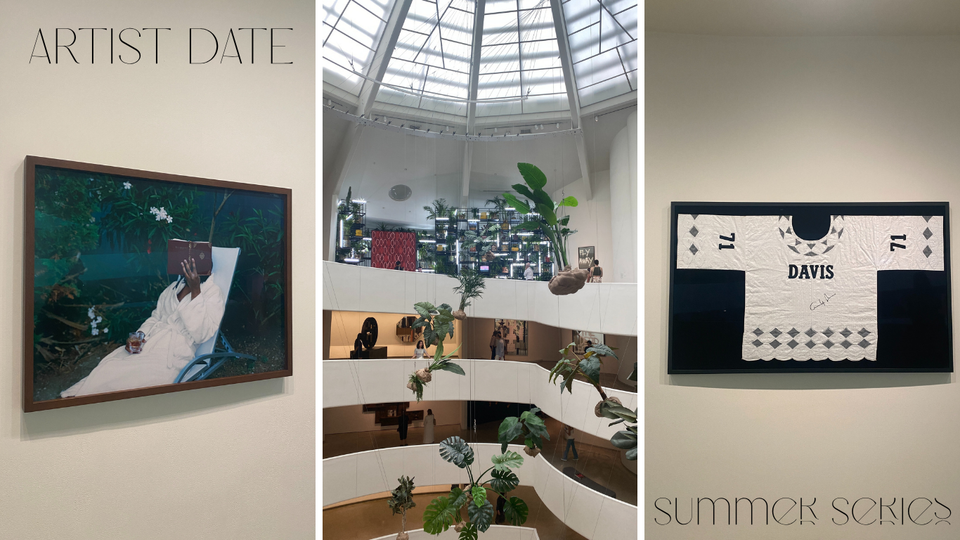
A Poem for Deep Thinkers, upon the initial phase of viewing, was intriguing as it showcases the artist's examination of how individuals can exist beyond historical forces through the lens of political movements. Johnson's art spanned multiple mediums, which I did enjoy seeing, ranging from sculptures and mixed media to videos and photography. How he commented on activism and political movements included the addition of certain books in his mixed-media artworks, such as The Wretched of the Earth by Frantz Fanon, and a sports jersey fashioned with Angela Davis' name on the back. The latter, I think, imagines what it would be like if we celebrated activists as much as we did athletes. Another memorable piece of artwork was a video of Johnson practicing yoga with no audio that speaks to his experience of attending a yoga class in a European country where he couldn't follow the instructions due to a language barrier.
On a surface level, it could seem that there was a stronger message about the Black identity, the artist's obligation to society, and the intersection of art and politics. But upon further reflection, I don't think it is as deep as it sets out to be.
My general feelings are confirmed when I read Seph Rodney's review of the show for Hyperallergic.
Essentially, I feel that the artworks by Johnson resemble that kid in class who talks around in circles using jargon to sound smart and make a point, but when you dissect it, they aren't saying anything meaningful at all. They might have some points, but there needs to be more reflection on the larger messaging at hand.
I highly recommend reading Seph Rodney's full review to get a better understanding of the exhibit at large and its downfalls. Rodney does a significantly better analysis of the exhibit than I ever can.
As I made my way up the gallery levels, the artworks felt less and less meaningful. At times, it feels like they're signifiers of identity slapped together to convey the Black experience through the repetitive use of shea butter, books by Black authors, and black soap paintings, yet the wall labels reiterate that the Black experience is not a monolith. In comparison to the likes of Carrie Mae Weems and Kehinde Wiley, I felt underwhelmed.
If you're unfamiliar with Carrie Mae Weems, I would encourage you to check out her Kitchen Table series, which is how I was first introduced to her work.
I'm curious to hear other people's thoughts on A Poem for Deep Thinkers. Please let me know if you've seen it!