The Era of Influencer Creep
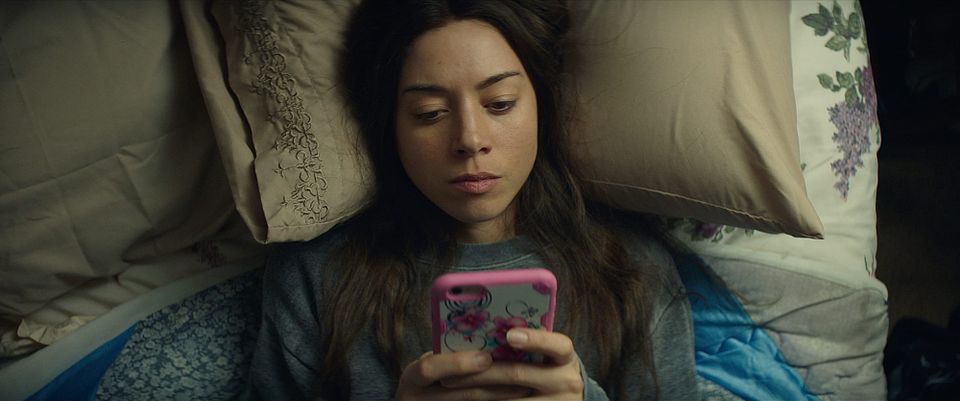
It has been approximately three full months of job hunting, during which I scour job boards and career pages every working day, consistently on the lookout for a role I can be passionate about. As a marketing girly, I tend to gravitate towards roles that fall within the scope of marketing, creative strategy, and trend forecasting.
Aside from the instability of the current job market, I have noticed an alarming new trend: job requirements that demand "being comfortable in front of the camera," and some even require a certain number of followers on personal social media channels to qualify for the role.
This expectation that professional competence is linked to digital visibility signals a worrying evolution.
The era of influencer creep has redefined the modern worker, transforming the job application process from a resume and cover letter submission into a demand for mandatory self-branding as unpaid labor. The blurred lines of personal vs professional boundaries and the misinterpretation of value for a manufactured persona are creating a higher barrier to entry for a standard mid-level role.
The demand for visible workers is, unfortunately, a natural extension of the shifting creator economy, where corporations are building the foundations of in-house content creator teams. Brands are learning that direct-to-consumer relationships thrive when fronted by a personality, not a corporate logo.
Social media expert Rachel Karten notes this shift as "creating content that leads with conversation, not conversion." The goal is to hook the audience with edutainment before gently selling the product or service.
An example of this is the TikTok creator, @olivia.unplugged, who is actually a brand account for the screentime app, Opal. Similarly, the popular mockumentary account, @roomiesroomiesroomies, has no overt branding in its content, instead prioritizing world-building and character-driven storytelling.
As social media overtakes television consumption, brands are realizing that this strategy creates a more engaged audience than relying solely on external influencers with a higher payoff. After all, the attention economy is highly competitive.
Hence, the expectation is that the in-house content creator must possess charisma, authenticity, and the ability to continuously generate content, which was once expected of a select group of influencers.
Self-Branding as Shadow Work
This increasing need to self-brand to remain valuable as a worker is what scholar Sophie Bishop terms "Influencer Creep."
Bishop captures this phenomenon succinctly, noting that the job of an influencer "involves learning how to constantly accommodate oneself to the means of establishing and maintaining visibility."
Bishop breaks the work down into three core pillars:
- consistent self-branding
- self-optimization for platforms
- commitment to selling authenticity
The first pillar is most evident on LinkedIn.
Once strictly a job-hunting platform, it now functions as an alternative Facebook where professionals share personal life anecdotes framed as career lessons. Recently, I saw a recruiter's post sharing the trend of companies prioritizing candidates who have a strong presence on LinkedIn, Instagram, or TikTok.
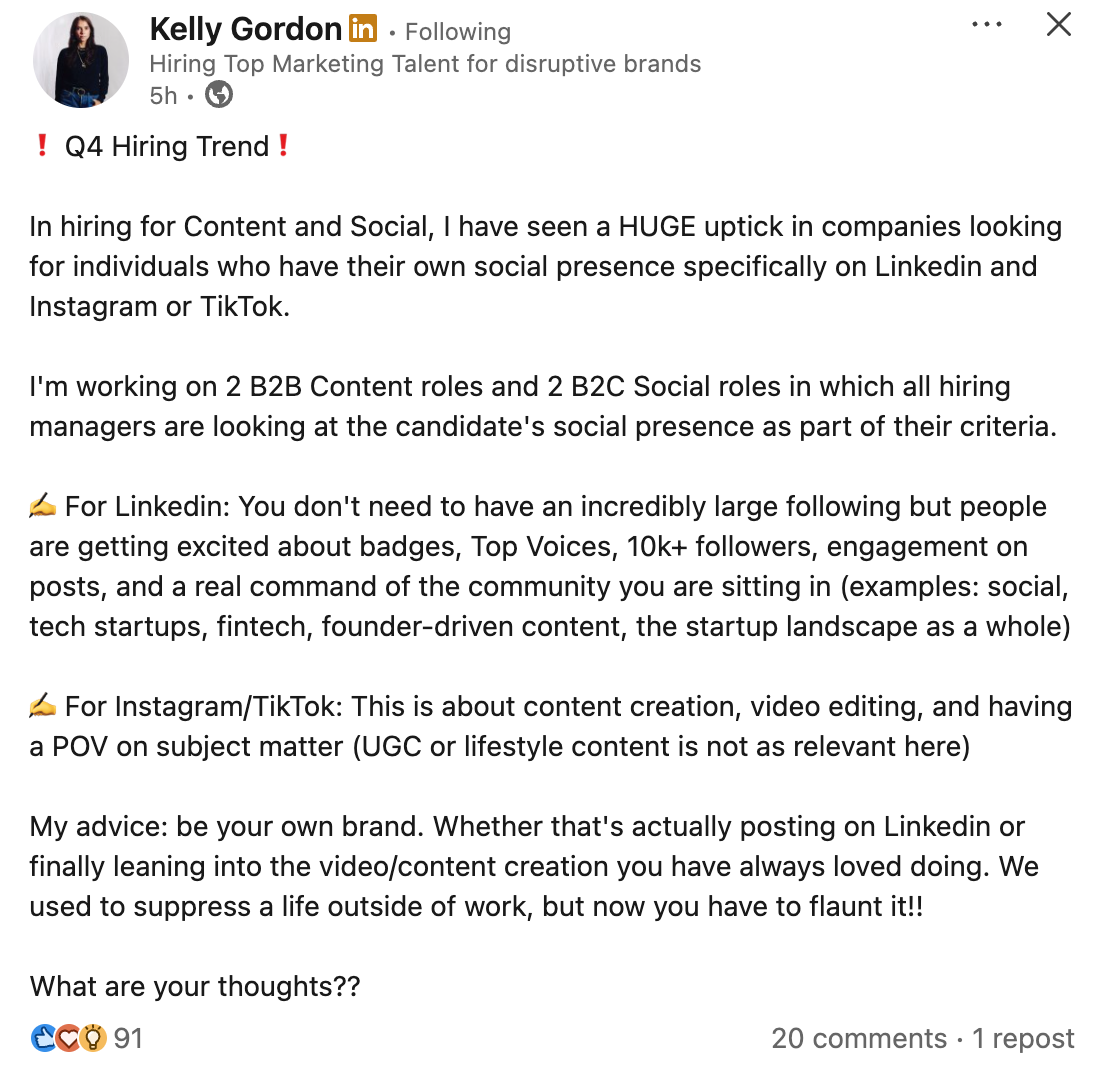
"We used to suppress a life outside of work, but now you have to flaunt it."
This expectation is problematic because it fundamentally bleeds unpaid work into personal time. When do you get to clock out? In this case, never.
Whenever I'm scrolling on social media, there’s a part of my brain identifying trends and finding strategies for a future campaign. On top of generating ideas for work, how does one have the time to strategize a personal brand?
This is essentially a second, mandatory, unpaid full-time job.
Reading the comments of the post, many social media managers echoed this sentiment, describing the inevitable burnout that comes with channeling vast amounts of creative energy into company accounts, only to be required to channel more energy into building personal socials. The boundaries between personal expression and entrepreneurship are fast eroding, I fear.
Boundaries between personal expression and entrepreneurship, between socializing and commerce, are eroded while the routine, mundane, and the everyday are painstakingly aestheticized. Workers must play to audiences, clients, bosses and platforms all at the same time, with no guarantee that any of it will pay off.
Self-Optimization in the Age of the Algorithm
On top of self-branding, there is also the constant evolution of social media to pay heed to. Workers must cater to audiences, clients, bosses, and platforms simultaneously, with no guarantee that any of it will pay off.
While maintaining a personal brand, the worker must constantly adapt to the unpredictable whims dictated by the tech giants' algorithms and the instability of the platforms themselves. The uncertainty over a potential TikTok ban earlier this year led to a "great migration" to alternatives like Xiao Hong Shu.
As Bishop notes, "reliance on platforms has come with a sense of anxiety about factors that remain in tech companies’ hands. The platform’s infrastructure can change or even disappear at any moment."
They must also develop a cross-platform brand, creating content specifically attuned to the different platforms’ tones, genres, and vernacular without compromising their own consistency.
This need for constant diversification is leading to a noticeable decline in the quality of independent content, such as newsletters and podcasts. It feels like everyone has a podcast or a newsletter, but how many of them are actually worth the time?
In an oversaturation of content and information, our attention is constantly being pulled in various directions. The expertise and time required to generate high-quality content are in decline during a time when content creators are attempting to master multiple distribution avenues.
Creatives need time to research, reflect, and digest. Instead, so many are expected to perform at an even greater speed than ever before with the proliferation of AI.
The Mark of the Influencer Creep
The commitment to selling authenticity is the most contradictory demand of the influencer creep.
The mark of influencer creep is the on-edge feeling that you have not done enough for social media platforms: that you can be more on trend, more authentic, more responsive — always more.
What does it mean to be authentic when every aspect of one's professional persona must be carefully curated, optimized, and performed for an audience of prospective employers?
In the era of influencer creep, authenticity is no longer a genuine reflection of ourselves as individuals; instead, it's a form of manufactured commodity, an asset to current and/or prospective employers.
The moments of vulnerability and personal struggle shared on LinkedIn are, for the most part, not genuine anecdotes. Instead, many of them are performative posts strategically designed to humanize the worker and signal their value as an employee.
I find the expectation to perform visibility extremely dehumanizing in a job market that demands so much of my humanity, yet relies heavily on Applicant Tracking Systems (ATS) and generative AI to parse resumes and cover letters. This means many applicants aren't even reviewed by a human being before receiving an automated rejection email.
Influencer Creep has not only entered the workplace, but it has also become the unspoken gatekeeper to securing employment, in which recruiters and HR personnel demand an "authentic and unique" sense of identity while simultaneously refusing to grant a semblance of humanity in the hiring process.
Unfortunately, I don't see a light at the end of the tunnel with AI replacing copywriters and digital designers. The latest text-to-video app by OpenAI, Sora, is so realistic that people can't even discern what's real or what's not anymore.
@vivthemole #greenscreen #marieclaire #substack #thecuttingroomfloor #tcrf
♬ original sound - Viv
As companies are casting their employment nets over influencers and content creators, I fear that visible personal branding will be a strict requirement down the line. The cost of securing full-time employment would inevitably mean the erasure of the private self as we enter this new era of the influencer creep.